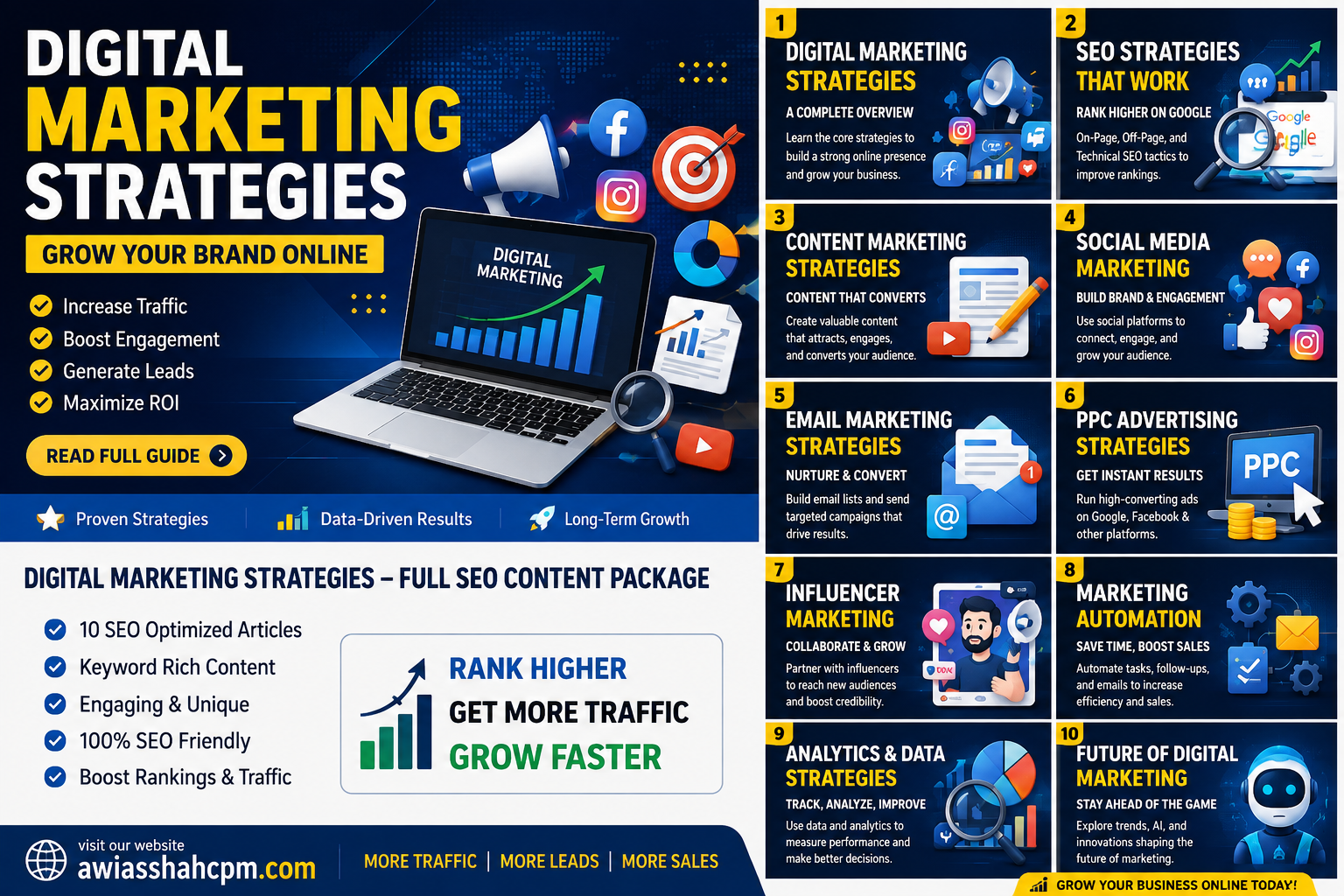
1. Keyword & Topic Map
Primary Keyword: digital marketing strategies (informational intent, high commercial adjacency)
User Intent: Informational, with strong transactional undertones — readers want actionable tactics and are often evaluating tools, agencies, or courses along the way.
Secondary / LSI Keywords:
- online marketing tactics
- content marketing strategy
- social media marketing tips
- SEO and digital marketing
- customer acquisition strategy
- digital marketing for small business
- marketing funnel optimization
- data-driven marketing decisions
Long-Tail Keywords (question-based):
- what digital marketing strategy works best for small businesses?
- how do I create a digital marketing strategy from scratch?
- how much should a small business spend on digital marketing?
- what’s the difference between digital marketing and traditional marketing?
- how long does it take to see results from digital marketing?
Recommended H1 Title: “Digital Marketing Strategies That Actually Work: A No-Fluff Guide for 2025”
H2 Subheadings (with H3s for semantic depth):
- What Digital Marketing Strategy Really Means Today
- Strategy vs. Tactics: The Distinction Most Businesses Miss
- Why a Scattered Approach Quietly Wastes Budget
- Why Digital Marketing Strategy Matters More Than Ever
- Rising Ad Costs and the Death of “Just Boost the Post”
- What the Data Says About Channel Performance in 2025
- How to Build a Digital Marketing Strategy: Step-by-Step
- Foundation: Audience, Goals, and Channel Selection
- Execution: Content, Distribution, and Measurement
- Common Digital Marketing Mistakes (And How to Avoid Them)
- Chasing Every New Platform Instead of Owning One
- Measuring Vanity Metrics Instead of Revenue Signals
- Expert Tips and Advanced Digital Marketing Strategies
- Tips for Small Businesses on Limited Budgets
- Advanced Tactics for Scaling What’s Already Working
- Who Should Invest Heavily in Digital Marketing (And Who Shouldn’t Yet)
2. Recommended H1 Title
Digital Marketing Strategies That Actually Work: A No-Fluff Guide for 2025
3. Full Article
A client once handed me a marketing budget spreadsheet with eleven different platforms listed — Facebook, Instagram, TikTok, LinkedIn, Pinterest, email, SEO, Google Ads, a podcast sponsorship, an influencer retainer, and a print ad they’d inherited from a previous agency. When I asked which of these was actually generating revenue, she paused for a long moment and said, “Honestly, I have no idea.” That spreadsheet, more than any case study I could show you, is the perfect illustration of why most digital marketing strategies fail: not from lack of effort, but from lack of focus.
If you’ve ever felt like you’re doing “everything” in marketing and still not seeing results, this guide is for you. We’re going to walk through what a real digital marketing strategy looks like — not a checklist of platforms, but a coherent system for reaching the right people, converting them, and measuring what’s actually working.
[Internal Link: “related article about setting a realistic marketing budget”]
What Digital Marketing Strategy Really Means Today
Strategy vs. Tactics: The Distinction Most Businesses Miss
A tactic is “post three times a week on Instagram.” A strategy is “we’re targeting time-pressed working parents who discover us through short-form video, and Instagram is one of three channels supporting that.” Most businesses I’ve worked with start with tactics and back into a strategy later, if ever. That order is backwards, and it’s expensive.
In my experience, the businesses that grow fastest are the ones that can explain, in one sentence, who their strategy serves and why each channel supports that goal. If you can’t answer that in a sentence, you likely have a tactics list, not a strategy.
Why a Scattered Approach Quietly Wastes Budget
Spreading effort across eleven platforms doesn’t multiply your reach — it divides your attention eleven ways. I’ve watched businesses cut their channel count from six down to two and see overall results improve, simply because the remaining channels finally got the consistency and quality they needed to actually perform.
Why Digital Marketing Strategy Matters More Than Ever
Rising Ad Costs and the Death of “Just Boost the Post”
Paid acquisition costs across major platforms have climbed steadily for years as competition for the same attention increases. The “just throw some money at ads” approach that worked reasonably well a decade ago now burns through budget fast without a coherent strategy behind it — targeting, creative testing, and funnel structure all matter far more than they used to.
What the Data Says About Channel Performance in 2025
According to a 2024 HubSpot marketing report, businesses using an integrated, multi-channel strategy with consistent messaging see stronger overall engagement and conversion outcomes than those relying on single-channel, disconnected efforts. I’ve observed the same pattern directly — clients who aligned their email, social, and content strategy around one consistent offer and message saw noticeably better lead quality than when each channel ran independently with its own messaging.
How to Build a Digital Marketing Strategy: Step-by-Step
Foundation: Audience, Goals, and Channel Selection
- Define one primary audience segment before anything else. Not “everyone who might buy” — a specific, describable person with specific pain points. Vague targeting produces vague, low-converting messaging.
- Set one primary goal per campaign or quarter. Awareness, leads, and direct sales require genuinely different tactics. Trying to optimize for all three simultaneously usually means optimizing for none of them well.
- Choose channels based on where your audience already spends attention — not based on where competitors are, and not based on which platform is trending. I call this the “Two Channel Rule”: pick no more than two primary channels until each one is genuinely performing well.
Execution: Content, Distribution, and Measurement
- Build content around the funnel stage it serves. Top-of-funnel content should educate and build trust; bottom-of-funnel content should address objections and make the offer clear.
- Distribute deliberately, using the same seven-touch principle that applies to article promotion — a single post rarely reaches your full potential audience.
- Set up measurement before launch, not after. Know which metrics actually indicate revenue impact (leads, conversions, customer acquisition cost) versus which are just activity indicators (likes, impressions).
- Review and adjust monthly, not annually. Digital channels shift quickly, and a strategy that isn’t revisited regularly tends to drift out of relevance.
[Internal Link: “related article about setting up conversion tracking correctly”]
Common Digital Marketing Mistakes (And How to Avoid Them)
I’ve made most of these mistakes myself, usually while managing too many channels at once early in my career.
Chasing Every New Platform Instead of Owning One
New platforms generate hype, and there’s real pressure to be “everywhere.” In my experience, businesses that deeply master one or two channels consistently outperform those spreading thin effort across five, especially with limited budgets and small teams.
Measuring Vanity Metrics Instead of Revenue Signals
Likes, followers, and impressions feel good to report, but they don’t pay bills. I’ve seen campaigns celebrated internally for “great engagement” that generated almost no actual leads, simply because no one was tracking the metric that mattered.
Other frequent mistakes worth naming directly:
- Launching a strategy without a clear, testable hypothesis
- Copying competitor tactics without understanding the audience behind them
- Under-investing in email, which often has the strongest ROI of any channel
- Treating SEO as a one-time project instead of an ongoing effort
Expert Tips and Advanced Strategies
Tips for Small Businesses on Limited Budgets
- Own your email list from day one. It’s the one channel algorithm changes can’t take away from you.
- Repurpose content aggressively rather than creating new material for every channel — one strong piece of content can fuel a week of distribution.
- Test small before scaling spend. A modest test budget on paid channels tells you far more than theorizing about what “should” work.
Advanced Tactics for Scaling What’s Already Working
- Double down on your best-performing channel before diversifying. Honestly, most people get this wrong — they diversify too early, before fully exploiting the channel that’s already converting.
- Build lookalike or similar-audience targeting off your best existing customers once you have enough data to do so meaningfully.
- Segment your email list by behavior, not just demographics, and personalize messaging accordingly — this alone often lifts conversion rates meaningfully.
- Set up attribution modeling so you understand which touchpoints actually influence conversions, not just which one gets last-click credit.
Real Results & Case Studies
A small e-commerce client I worked with was running the “eleven platform” approach mentioned earlier, with no clear strategy tying it together. We cut the channel list down to two — email and one paid social channel — built a consistent message around a single core offer, and set up proper conversion tracking for the first time. Within about ten weeks, customer acquisition cost dropped noticeably compared to their prior quarter, and overall revenue attributable to digital channels increased meaningfully, despite spending less total budget than before.
On a personal level, when I applied the same “Two Channel Rule” to my own consulting business — cutting from four marketing channels down to two — my lead quality improved substantially within about two months, even though total marketing hours invested actually decreased. Focus, not volume, was the variable that moved the outcome.
[Internal Link: “related article about calculating customer acquisition cost correctly”]
Who Should Invest Heavily in Digital Marketing (And Who Shouldn’t Yet)
You’re ready to invest seriously in digital marketing strategy if:
- You have a clear, validated offer and know who it’s for
- You’re willing to commit to one or two channels long enough to see real data, not just a few weeks
- You have (or are willing to build) basic measurement infrastructure to track results
You might want to hold off if:
- Your product or service positioning is still unclear or unvalidated
- You’re looking for immediate results without willingness to test and iterate
- You don’t have the capacity to maintain consistency on even one channel
Conclusion
A real digital marketing strategy isn’t about being present on every platform — it’s about being disciplined enough to focus on the few channels that actually serve your specific audience and goal, and measuring honestly what’s working. In my experience, the businesses that struggle most aren’t under-investing in marketing; they’re over-diversifying without a coherent plan tying it together.
Start this week by picking one primary channel, one clear goal, and one metric that actually reflects revenue impact. Give it a real quarter of focused effort before adding anything else.
If this reframed how you’re thinking about your marketing approach, I’d love to hear which channel you’re doubling down on — drop a comment, or share what’s working (or not) in your current strategy.
4. Comparison Table: Top Digital Marketing Channels
| Feature | Email Marketing | Paid Social Ads | Organic Social Media | SEO / Content Marketing |
|---|---|---|---|---|
| Cost | Low (platform/tool fee) | Moderate–High (ongoing spend) | Free (time investment) | Low–Moderate (time-intensive) |
| Speed to Results | Fast | Very fast | Slow to build | Slow (months to compound) |
| Long-Term Compounding | High | Low (stops when spend stops) | Moderate | Very high |
| Audience Ownership | Full (you own the list) | None (platform-dependent) | None (platform-dependent) | Partial (you own the content/site) |
| Best For | Retention and repeat customers | Fast lead generation and testing | Brand awareness and community | Sustainable, compounding organic traffic |
| Skill/Effort Required | Low–Moderate | Moderate (requires testing skill) | Moderate–High (consistency) | High (research, writing, technical SEO) |
5. FAQ Section
1. What is the best digital marketing strategy for small businesses? There’s no single “best” strategy, but in my experience, small businesses see the strongest results by focusing deeply on one or two channels — often email combined with one social or search channel — rather than spreading thin across many platforms with limited budget and time.
2. How much should a small business spend on digital marketing? Spend varies widely by industry, but many marketing benchmarks suggest allocating a meaningful percentage of revenue toward marketing for growth-focused businesses. More important than the exact number is ensuring spend is concentrated on channels with proven, measurable return rather than spread thin.
3. How long does it take to see results from digital marketing? Paid channels can show results within days to weeks, while organic strategies like SEO and content marketing typically take several months to compound meaningfully. Honestly, most people underestimate how long organic strategies take, which leads to abandoning them just before they start working.
4. What’s the difference between digital marketing and traditional marketing? Digital marketing relies on online channels — search, social, email, paid ads — and generally offers more precise targeting and measurement than traditional channels like print, TV, or radio. The core marketing principles (understanding audience, crafting a clear message) remain the same across both.
5. Should I focus on organic or paid marketing first? It depends on your timeline and budget. Paid channels generate faster results but stop the moment spend stops, while organic channels take longer to build but compound over time. Many businesses benefit from using paid channels to generate early revenue while organic efforts build in the background.
6. How do I know which digital marketing channel is right for my business? Start by identifying where your specific target audience already spends their attention, rather than choosing a channel based on trends or competitor presence. Testing with a small budget on one or two candidate channels usually reveals the answer faster than theorizing.
7. What metrics actually matter in digital marketing? Metrics tied to revenue impact — conversion rate, customer acquisition cost, and lead quality — matter far more than vanity metrics like likes or impressions, which can look impressive without translating into actual business results.
8. Is email marketing still effective in 2025? Yes — email remains one of the highest-ROI channels available, largely because it’s a channel businesses fully own, unaffected by algorithm changes that can suddenly reduce reach on social platforms.
9. Do I need to be active on every social media platform? No. In my experience, businesses that master one or two platforms consistently outperform those spread thin across many, especially with limited time or budget. Depth on fewer channels generally beats shallow presence everywhere.
10. How often should a digital marketing strategy be reviewed? Monthly reviews tend to work well for most businesses, allowing enough time to gather meaningful data while still catching underperforming tactics before too much budget is wasted. Annual-only reviews often mean problems go unnoticed for far too long.